
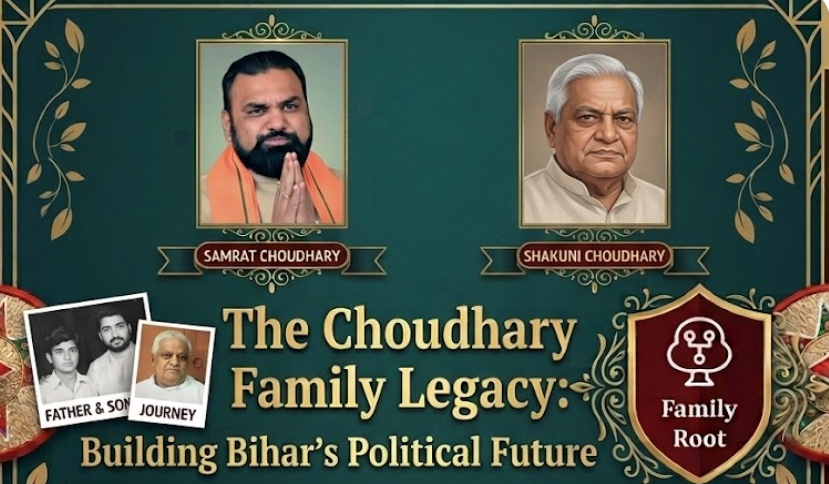
Behind every great leader is a family story that shaped who they became. In the case of Samrat Chaudhary — the Chief Minister of Bihar and the first-ever BJP leader to hold the top post in the state — that story begins in a small village in Munger district, winds through decades of grassroots politics across multiple parties, and ultimately arrives at the helm of a state of over 120 million people. His is a tale of political inheritance, personal ambition, community identity, and a family that has served Bihar's public life for three generations.
Early Life and Family Origins
Samrat Choudhary was born on 16 November 1968 in Lakhanpur village of Munger district, Bihar. He is also known by his alias Rakesh Kumar. Wikipedia
His ancestral roots lie in the Lakhanpur village of Tarapur block in Munger — a region where the Choudhary family has held deep political influence for decades. He belongs to the Koeri (Kushwaha) community, which is recognised as an Other Backward Class (OBC) in Bihar. OneIndia
What makes the Choudhary family especially remarkable is that politics was not just a career — it was a family inheritance. Both of Samrat's parents were elected legislators, making this one of Bihar's most distinguished political families across generations.
His Father: Shakuni Choudhary — The Patriarch of a Political Dynasty
To understand Samrat Chaudhary, one must first understand his father, Shakuni Choudhary (born 4 January 1936), one of Bihar's most enduring political figures.
Shakuni Choudhary was born in the same Lakhanpur village of Munger district. Before entering politics, he served in the Indian Army for 15 years — a formative chapter that gave him discipline and a sense of public duty. Wikipedia
He was a six-time (some sources say seven-time) MLA from the Tarapur Assembly constituency in Munger district, representing it across different political formations — from Independent, to Indian National Congress, to Samata Party, to Rashtriya Janata Dal, and eventually Hindustani Awam Morcha. He was also elected to the Lok Sabha from the Khagaria constituency as a member of the Samata Party — making him both a state legislator and a Member of Parliament during his long career. Wikipedia
Shakuni Choudhary was a founding member of the Samata Party and, as a Kushwaha community leader, was central to the "Luv-Kush" social coalition that shaped Bihar politics for decades. He was once considered close to both Lalu Prasad Yadav and Nitish Kumar — a measure of his ability to navigate Bihar's complex political landscape. The Print
When Samrat was appointed Deputy Chief Minister in 2024, Shakuni Choudhary told ABP News that his son's elevation was "the outcome of 20 years of penance" and expressed his hopes that Samrat would one day become Chief Minister too — a wish that came true on 15 April 2026. SaveDaughters
His Mother: Parvati Devi — A Legislator in Her Own Right
Samrat Chaudhary's mother, Parvati Devi, is not simply a political spouse — she is a politician in her own right. She served as a Member of the Legislative Assembly from the Tarapur constituency, elected in a by-election in 1998. The Perfect Voice
The significance of this cannot be overstated. In a state and era when women's political participation was limited, Parvati Devi stood for election and won — from the very constituency that her husband had represented for years, and that her son would later win as well. The Tarapur seat is, in a real sense, a family legacy passed down through three generations of the Choudhary family.
Education: Early Roots and Higher Learning
Samrat Chaudhary completed his basic education locally in Munger before pursuing higher studies at Madurai Kamaraj University in Tamil Nadu — an institution far from Bihar, reflecting his willingness to look beyond his home state for his academic formation. Wikipedia
His educational qualifications have at times been a subject of political controversy — an issue that surfaced particularly in the 2025 Bihar election campaign. However, none of the allegations resulted in any legal finding against him, and the controversy did not prevent him from winning his assembly seat with a strong majority. The Print
What is undisputed is that Samrat Chaudhary's real education came from the political world he was immersed in from childhood — watching his father navigate party shifts, constituency campaigns, and state-level governance across four decades.
His Wife: Mamta Kumari
Samrat Chaudhary is married to Mamta Kumari, who has stood by his side through his long and eventful political journey across multiple parties and roles. Wikipedia
Mamta Kumari has been visible in public life particularly during election campaigns and community outreach activities. Her assets are jointly declared in Samrat's election affidavits as part of Bihar's election transparency framework. Sunday Guardian Live
Far from being a distant figure, Mamta Choudhary has been visible in public outreach during elections — a characteristic of political families in Bihar where community relationships and personal accessibility are essential to political survival. Dynamite News
Their Children: The Next Generation
Samrat Chaudhary and Mamta Kumari have two children — a son, Pranam Priyam, and a daughter, Charu Priya. SaveDaughters
As the children of one of Bihar's most prominent political families, Pranam Priyam and Charu Priya have grown up at the intersection of public life and community identity — with their grandfather's legacy of decades in Bihar's legislature and their father's journey from agriculture minister to chief minister as the backdrop to their childhoods.
Brothers: A Family Rooted in Political Life
The Choudhary family's political involvement extends to Samrat's brothers as well. His elder brother is associated with Janata Dal (United) — a different party from Samrat's BJP, reflecting the complex, cross-party nature of Bihar's political families. His younger brother is involved in social work. Dynamite News
This multi-party family dynamic is not unusual in Bihar — a state where political allegiances have often been personal and pragmatic rather than purely ideological, and where family ties frequently transcend party lines.
The Choudhary Family Tree at a Glance
Grandparents' Generation
- Ancestral village: Lakhanpur, Tarapur block, Munger district, Bihar
- Community: Koeri (Kushwaha) — OBC
Parents
- Father: Shakuni Choudhary (born 4 January 1936) — Army veteran, founding member of Samata Party, six/seven-time MLA from Tarapur, Member of Parliament (Khagaria, Lok Sabha)
- Mother: Parvati Devi — MLA from Tarapur constituency (by-election, 1998)
Samrat Choudhary
- Born: 16 November 1968, Lakhanpur village, Munger district, Bihar
- Also known as: Rakesh Kumar
- Education: Madurai Kamaraj University
- Community: Koeri (Kushwaha)
Wife: Mamta Kumari
- Active in community outreach and election campaigns
- Assets jointly declared in election affidavits
Children
- Son: Pranam Priyam
- Daughter: Charu Priya
Brothers
- Elder brother: Associated with Janata Dal (United)
- Younger brother: Involved in social work
Political Career: From Agriculture Minister to Chief Minister
Samrat Chaudhary's political journey spans over three decades and carries the hallmarks of Bihar's dynamic, party-shifting political culture.
He entered active politics in 1990, initially aligning with Lalu Prasad Yadav's Rashtriya Janata Dal. On 19 May 1999, he was sworn in as Minister of Agriculture in the government of Rabri Devi — though he was soon removed from the post amid controversy over his age. OneIndia
In 2000, he was elected as an MLA from the Parbatta constituency with the RJD, and was re-elected from the same seat in 2010. In 2010, he was made the Chief Whip of the opposition in the Bihar Legislative Assembly. Wikipedia
A defining moment came in 2014, when Samrat orchestrated a split in the RJD, engineering the defection of thirteen MLAs. He then moved to the Jitan Ram Manjhi-led government, where he served as Minister of Urban Development and Housing. Wikipedia
In 2017, he joined the Bharatiya Janata Party — and found in the BJP a political home that recognised his value as a fiery speaker, an OBC leader, and a seasoned organiser. By 2018, he was appointed BJP State Vice President for Bihar. In March 2023, he was appointed President of BJP Bihar State Unit, a post he held until July 2024. OneIndia
In November 2025, he contested and won the Tarapur constituency — the same seat his mother had won and his father had represented for decades — with 122,480 votes, defeating his RJD opponent by 45,843 votes. OneIndia
On 15 April 2026, Samrat Choudhary was sworn in as Chief Minister of Bihar — making history as the first BJP leader ever to hold Bihar's top post. Wikipedia
The rise of Amit Shah had projected him publicly as a chief ministerial candidate at a Tarapur rally in October 2025, saying that if Samrat wins, "Modi will make him a very important person." The voters obliged — and the BJP kept its word. The Print
The Saffron Vow: A Symbol of Conviction
One of the most striking images from Samrat Chaudhary's political journey is that of him wearing a saffron turban as a vow — a public commitment to keep wearing it until the BJP returned to power in Bihar. In July 2024, after the NDA's political consolidation, he completed this vow at Ayodhya. OneIndia
The gesture was more than political theatre. It was a declaration of identity, belief, and persistence that resonated deeply with his supporters in Bihar's Koeri-Kushwaha belt.
The "Luv-Kush" Factor: Family, Caste, and Political Legacy
Samrat Chaudhary's rise cannot be separated from the community identity his family has embodied for generations. The Kushwaha community constitutes 4.2 per cent of Bihar's population, and combined with Kurmis, the "Luv-Kush" social coalition accounts for over 7 per cent of voters — a decisive bloc in many constituencies. The Print
His father Shakuni Choudhary was a central figure in this community coalition for decades. Samrat has carried that mantle forward, becoming the BJP's most prominent OBC face in Bihar — a leader who connects the party to a voter base it needed to consolidate.
This is what makes the Choudhary family story so significant in Bihar's political history: it is not just one man's rise, but a community's rise, expressed through three generations of the same family.
What the Choudhary Family Story Teaches Us
The Samrat Chaudhary family tree is a powerful illustration of how deeply a family's roots shape public life. A father who served in the Army before entering politics. A mother who won her own legislative seat. A son who absorbed decades of political wisdom from his household and carried it across five different parties before finding his home — and his moment — in the BJP.
From Lakhanpur village in Munger to the Chief Minister's chair in Patna, the Choudhary family's journey is a story of Bihar itself — its complexity, its caste equations, its political dynamism, and its fierce family loyalties.
For those interested in family history and genealogy, the Choudhary family reminds us that understanding a leader fully means understanding the family they came from. The village, the parents, the community — these are not biographical footnotes. They are the foundation.
Want to document your own family's history, heritage, and roots for future generations? Start building your family tree today — where every family story, from Lakhanpur to Patna, deserves to be remembered.
👉 Start building your family legacy today with Family Root App
- Android: Family Root App on Google Play
- iOS: Family Root App on Apple Store
📜 Disclaimer The family tree and biographical information provided in this article are based on publicly available sources and records. While we strive for accuracy, we do not guarantee the completeness or authenticity of all data. This content is intended for educational and informational purposes only and does not aim to infringe on any individual's privacy or personal rights. If you believe any information is incorrect or wish to request edits or removal, please contact us at Info@familyrootapp.com.