
We live in an age of extraordinary connection — and extraordinary disconnection. A parent can video call a grandparent on another continent in seconds, yet struggle to hold a proper conversation with their teenager sitting at the same dinner table. Families share photos online with hundreds of followers while missing the quiet moments happening right in front of them.
The digital age has not weakened the family. But it has quietly reshaped how families spend their time, communicate, and show up for one another — often without anyone noticing until the distance already feels real.
The good news is this: technology itself is not the enemy. It is how we use it — or allow it to use us — that determines whether it pulls families together or quietly drives them apart. With intention and a few practical strategies, you can build a family culture that is both connected to the modern world and deeply rooted in genuine human bonds.
Understanding the Challenge First
Before jumping to solutions, it helps to understand what we are actually up against. The average person now spends over six hours a day looking at screens. For children, that number is often higher. Social media platforms, streaming services, and gaming ecosystems are intentionally designed to be as engaging as possible — capturing attention and holding it for as long as they can.
This is not a moral failing. It is by design. And once you understand that, you stop blaming yourself or your children and start making conscious choices instead.
The challenge for modern families is not eliminating technology — that ship has sailed, and in many ways, technology genuinely enriches our lives. The challenge is ensuring that screens serve the family, rather than competing with it.
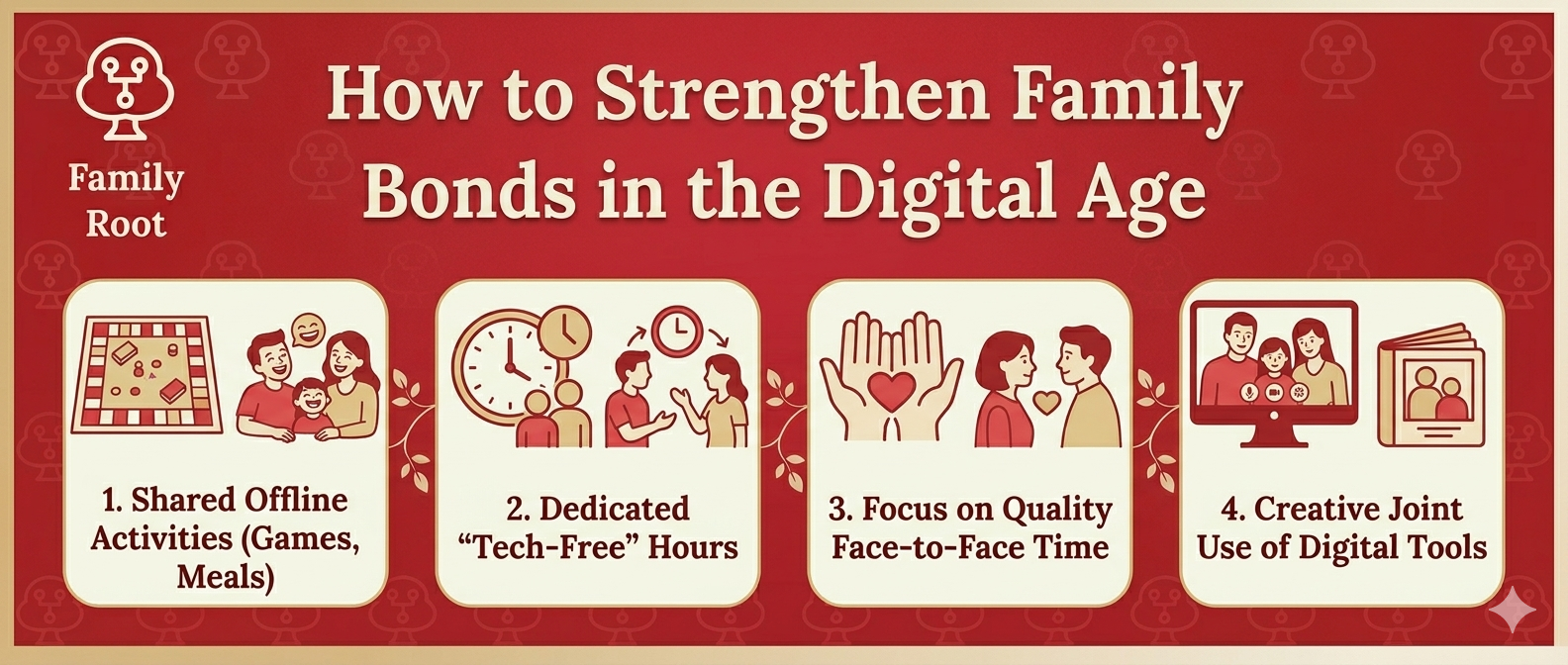
1. Create Tech-Free Zones and Times — Protect the Sacred Spaces
Every home needs spaces and moments where screens simply do not belong. These are the environments where real conversation, eye contact, laughter, and presence happen naturally — because there is no alternative distraction pulling attention away.
The dinner table is the single most powerful tech-free zone a family can establish. Research consistently shows that families who eat together regularly — without phones — have children who perform better academically, struggle less with mental health issues, and feel more emotionally secure. A meal shared without screens is not just food. It is communication, belonging, and love expressed through time.
Other powerful tech-free zones to consider:
- Bedrooms at night (for children and adults alike — phones charge outside the room)
- The first 30 minutes after school or work, reserved for reconnecting
- Family car journeys — some of the most meaningful conversations happen when you are looking ahead, not at each other
- Sunday mornings, or whatever your family's natural "slow" time might be
The key is consistency. A boundary that disappears the moment someone complains is not a boundary — it is a suggestion. Hold the line warmly but firmly, and explain the why to your children: "This is our time. It matters more than any notification."
2. Use Technology Intentionally as a Bonding Tool
Here is the reframe that changes everything: technology does not have to be the threat to family bonding. Used with intention, it can be one of the most powerful tools for bringing families closer — especially across distances.
Video calls with grandparents, aunts, uncles, and cousins who live far away are genuinely miraculous. A generation ago, those relationships would have faded to birthday cards and occasional visits. Today, a grandparent can read a bedtime story to a grandchild on another continent every single night.
Family group chats, shared photo albums, and collaborative playlists are small but meaningful ways technology weaves daily family life together. Some families use private shared journals or apps specifically designed for family communication and memory-keeping — tools that bring everyone into the same story rather than scattering them across different platforms.
The question to ask of every piece of technology in your home is simple: does this bring us together, or does it pull us apart? The answer determines how much space it earns in your family life.
3. Co-Engage Rather Than Compete With Screens
One of the most effective — and underused — strategies for reclaiming family connection in the digital age is sitting alongside your child in their digital world rather than standing outside it, asking them to come out.
Watch the YouTube video they cannot stop talking about. Ask them to show you their favourite game and genuinely try to play it. Watch a series together as a family event, not as separate individuals on separate devices in separate rooms. When a parent takes interest in what captivates their child — even if it is completely outside their own taste — the message the child receives is profound: you matter enough for me to enter your world.
This approach also gives parents natural, non-confrontational entry points for conversations about online safety, content choices, and responsible digital behaviour. You cannot guide your child through a world you refuse to understand.
4. Build Offline Rituals That Everyone Looks Forward To
Rituals are the architecture of family life. They create rhythm, predictability, and shared identity — and they are one of the most powerful antidotes to the pull of screens, because they offer something screens cannot replicate: real sensory experience shared with the people you love.
Strong family rituals do not need to be grand. They need to be consistent and genuinely enjoyable for everyone involved. Ideas that work beautifully across different family types:
- A weekly family movie night with homemade popcorn and everyone's input on the film choice
- A monthly "family adventure day" where you explore somewhere new together — a hiking trail, a local market, a museum
- A Sunday cooking tradition where one family member picks the recipe and everyone helps make it
- An annual trip or staycation that the whole family plans together, building anticipation all year
- Game nights with board games or card games — a screen-free space full of laughter and friendly competition
The magic of rituals is that they become part of a family's identity. Children grow up and say, "In our family, we always..." — and those traditions become the thread that holds relationships together even when life pulls people in different directions.
5. Teach Digital Literacy, Not Just Digital Restriction
Telling children to "put their phones away" without explaining why, or without any conversation about the nature of digital life, creates a battle of wills rather than a foundation of wisdom. The families who navigate the digital age most successfully are those who treat technology as something to understand and manage — not something to fear and forbid.
Digital literacy means teaching children to ask important questions: Why was this designed to keep me scrolling? How does this platform use my attention? How do I feel after spending an hour here — better or worse? Is what I just read true, and how would I check?
These are not abstract conversations — they are some of the most important skills a person can develop in the modern world. When children learn to be thoughtful and critical digital citizens, they are less vulnerable to the manipulative design patterns that plague social media and more capable of using technology as the tool it was meant to be.
6. Model the Behaviour You Want to See
Every conversation about screen time in the family needs to begin with an honest look in the mirror. Children do not do what parents say — they do what parents do. If a parent is unreachable behind a phone during family dinner, or reflexively reaches for their device during quiet moments, that behaviour is teaching a powerful lesson.
This is not about guilt. It is about awareness and intention. The most meaningful change many families can make is not a new rule for the children — it is a new standard the adults hold for themselves. When children see a parent choose a conversation over a notification, or put their phone away at the dinner table without being asked, they absorb that as the norm.
The family you want to lead is the family you have to demonstrate every single day.
7. Stay Curious About Each Other's Inner Lives
The deepest family bonds are not forged through activities — they are forged through knowing and being known. In the digital age, it is remarkably easy for family members to live parallel lives under the same roof, each absorbed in their own digital universe, with very little genuine knowledge of what the other person is thinking, feeling, or going through.
Make it a practice to ask real questions — and to actually wait for the answer. Not "How was your day?" but "What was the most interesting thing that happened to you today?" Not "Are you okay?" but "You seem like something is on your mind. Want to talk about it?"
Curiosity is an act of love. When you are genuinely curious about the inner life of your spouse, your child, your parent — you are telling them: you matter to me. I want to understand you. I am paying attention. No screen can offer that. Only people can.
8. Use Your Family's Digital Life to Preserve Your Story
One of the most beautiful opportunities the digital age offers families is the ability to document and preserve family history like never before. Photos, videos, voice recordings, shared family timelines, and collaborative family trees are tools that previous generations could only dream of.
A family that actively documents its story — through regular photo albums, shared memory apps, or a family tree platform — is investing in connection that transcends individual lifetimes. Children who grow up knowing their roots, their ancestors' stories, and their family's journey carry a sense of identity and belonging that shapes who they become.
This is exactly why platforms like ours exist: to give families a private, meaningful digital space where they can share, preserve, and connect around the things that matter most — not the noise of the internet, but the story of your own people.
Final Thoughts
The digital age presents real challenges for families — but it also offers extraordinary opportunities. The families who will thrive are not those who reject technology, nor those who are consumed by it. They are the families who use it with intention, protect their time together fiercely, and never lose sight of the truth that no app, platform, or device can replicate what it feels like to be truly seen, heard, and loved by the people who matter most.
Your family's story is worth protecting. Start with one small change this week — one tech-free dinner, one shared experience, one genuine question — and build from there.
Because the best connection is not measured in signal strength. It is measured in the moments when you are fully, undividedly there for each other.
Looking for a better way to stay connected with family near and far? Our platform gives your family a private, secure space to share memories, build your family tree, and stay close — no algorithm required.
Want to preserve your family's story and values for future generations? Start building your family tree today on our platform — connect with relatives, document your heritage, and create a legacy that lasts.
👉 Start building your family legacy today with Family Root App
- Android: Family Root App on Google Play
- iOS: Family Root App on Apple Store