
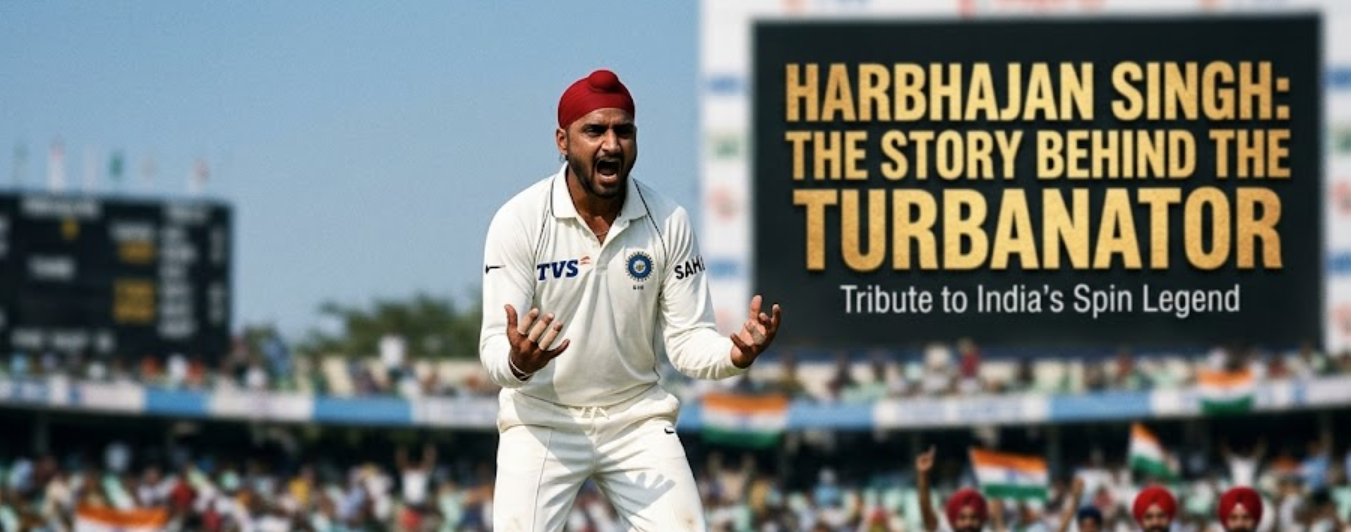
In the gallery of India's cricket greats, Harbhajan Singh occupies a place of special honour. The boy from Jalandhar who took a Test hat-trick at the age of 20 against Australia — the first Indian to ever do so — the spinner who almost single-handedly won the Kolkata Test of 2001, the "Turbanator" who spun India to two World Cups — he is one of the most beloved and colourful figures the game has produced. Known to fans across India simply as Bhajji, he has built a life as a cricketer, a commentator, a film actor, and a Member of Parliament. But behind every wicket, every celebration, and every comeback lay a family story rooted in the Punjabi Sikh tradition of courage, sacrifice, and unshakeable love.
This is the story of that family.
Family Roots: The Ramgarhia Sikhs of Jalandhar
The Harbhajan Singh family belongs to the Sikh Ramgarhia community — one of Punjab's most distinguished Sikh sub-groups, traditionally associated with skilled craftsmanship, engineering, and entrepreneurship. Wikipedia
The family's roots lie firmly in Jalandhar, one of Punjab's oldest and most storied cities — a place of deep Sikh heritage, legendary sporting culture, and a long tradition of producing cricketers, wrestlers, and sportsmen who have carried the Punjabi spirit of resilience onto the national stage. Jalandhar has given Indian cricket several of its most combative and expressive players, and Harbhajan Singh — born, raised, trained, and still residing in the city — is the most famous of them all.
His full surname is Plaha — Harbhajan Singh Plaha — a family name that reflects his Ramgarhia Sikh heritage. In cricket, as in life, he is known simply as Harbhajan Singh or Bhajji.
His Father: Sardar Sardev Singh Plaha — The Freedom Fighter Who Chose Cricket
The most important figure in the Harbhajan Singh family story is his father, Sardar Sardev Singh Plaha — a man whose life carried the weight of Indian history and the lightness of a father's unconditional love.
Sardar Sardev Singh Plaha was a freedom fighter — a man who had participated in India's independence struggle before building his post-independence life in Jalandhar. He owned and operated a ball bearing and valve factory in the city — a modest but successful business that sustained a family of seven children: one son and five daughters. Wikipedia
As the only son in a Punjabi household of the 1980s and 1990s, Harbhajan was the natural heir to his father's factory. It was understood, at least initially, that he would eventually take over the family business — continue the work that Sardev Singh had built from scratch, support his five sisters, and carry the family's economic life forward.
But Sardar Sardev Singh saw something in his youngest child that made him reconsider that plan entirely.
When the young Harbhajan showed exceptional cricket ability — especially after his first coach Charanjit Singh Bhullar spotted his talent and began training him — it was his father who made the decisive call. He told Harbhajan to forget the factory and concentrate entirely on cricket. He told his son that representing India was a greater inheritance than any manufacturing business. Wikipedia
It was the kind of decision that requires both love and courage — the courage to let go of a plan, to trust a teenager's talent, and to absorb the financial uncertainty that came from having your only son pursue sport rather than business. Sardar Sardev Singh Plaha made that decision without hesitation.
He did not live long enough to see the full fruits of that decision. In 2000, Sardar Sardev Singh Plaha passed away — when Harbhajan had been playing for India for just two years, and before the great 2001 series against Australia that would make his son a national hero. SportsDunia
He never saw the hat-trick. He never saw the 32 wickets in three Tests against Australia. He never saw the Wankhede in 2011, or the four IPL trophies, or the Rajya Sabha oath. But without his decision — his father's insistence that a boy from Jalandhar should play cricket for India — none of it would have happened.
After his father's death, the 20-year-old Harbhajan became the head of the family — taking on the responsibility of supporting his mother and arranging the marriages of his three elder sisters, all while playing international cricket at the highest level. By 2001, he had arranged all three weddings. The burden he carried in those years — grief, responsibility, and the pressure of carrying a nation's hopes as a spinner — is almost impossible to overstate. Wikipedia
His Mother: Avtar Kaur — The Homemaker Who Never Stopped Believing
Avtar Kaur is Harbhajan's mother and the quiet, steadfast heart of the Plaha family.
A homemaker who devoted herself entirely to raising her six children in Jalandhar, Avtar Kaur was the constant emotional anchor of Harbhajan's early life. She supported his cricket career through every stage — from the long morning training sessions as a boy to the anxious days of early international cricket. SuccessCDS
After her husband's death in 2000, it was Avtar Kaur who held the family together while her son — barely 20 years old and already carrying India's bowling attack — bore the responsibility of the household. The combination of a grieving mother and a grieving son, both choosing not to collapse under the weight of loss, is one of the unwritten stories of the 2001 Australia series that changed Indian cricket history.
She continues to live in Jalandhar, close to her son and his family, as she has always done — a woman whose quiet strength found its fullest expression in the world-class cricketer she helped raise.
His Five Sisters — The Household That Shaped Him
One of the most distinctive and humanising features of the Harbhajan Singh family story is that he grew up as the only son among five sisters — four older than him and one younger. SportsDunia
Growing up surrounded by sisters in a Punjabi household is an education in itself — in patience, in emotional intelligence, in the art of living within a large, close-knit family where every relationship carries weight and every decision has consequences. Those who have played with and coached Harbhajan often speak of his loyalty to his teammates, his fierce protectiveness of people he considers his own, and the emotional directness that has sometimes landed him in controversy. All of these qualities were forged, at least in part, in a Jalandhar home where five sisters and one brother shared everything.
The one sister whose name is publicly known is Sandeep Kaur. Famous Birthdays
After his father's death in 2000, Harbhajan took on the traditional role of the family elder — arranging the marriages of his three elder sisters by 2001, even as he was dismantling Australia's batting lineup with his off-spin. It was an act of profound family responsibility that most commentators on the 2001 series never knew was happening off the field.
His Wife: Geeta Basra — The British Punjabi Actress
The love story of Harbhajan Singh and Geeta Basra is one of Indian sport's most warmly regarded romances — a Jalandhar boy and a Portsmouth girl, brought together by a music video, a phone number passed via a teammate, and years of patient, private love.
Geeta Basra was born on 13 March 1984 in Portsmouth, on England's south coast, to Indian Punjabi parents — making her a British-Indian whose roots, like Harbhajan's, lie in the Punjabi community. She has a younger brother, Rahul, and a sister, Ruby. Wikipedia — Geeta Basra
Geeta grew up in Portsmouth, completing her schooling at Portsmouth High School before moving to India to pursue an acting career. She enrolled at the Kishore Namit Kapoor Acting Institute in Mumbai and made her Bollywood debut in 2006 in Dil Diya Hai — the Emraan Hashmi-starrer that gave her a first splash of recognition.
The story of how Harbhajan and Geeta met is one of Indian cricket's best-kept open secrets. Harbhajan first saw Geeta in the music video for the song Woh Ajnabee from her film The Train (2007) — and it was, by several accounts, almost love at first sight. He obtained her phone number through his India teammate Yuvraj Singh, who was friends with Geeta at the time. Tring
They began a relationship that they kept deliberately private for years — navigating the pressures of cricket schedules, Bollywood commitments, and the expectations of two large Punjabi families — before finally marrying on 29 October 2015 in a traditional Sikh ceremony in Jalandhar. The wedding was both a homecoming and a celebration — Harbhajan's city, his community, his family, and the woman he had waited a decade to marry, all in one place. Wikipedia — Geeta Basra
After her marriage, Geeta stepped back from active Bollywood work to focus on her family — though she has remained a visible presence at cricket events and on social media, and she and Harbhajan co-host a YouTube show called Who's The Boss, where cricketers and their wives discuss their relationships. She has also appeared in Punjabi films and worked as a brand ambassador for several companies.
Their Children: Hinaya and Jovan
Harbhajan Singh and Geeta Basra have two children — a daughter and a son — whose names carry the family's Punjabi Sikh heritage in every syllable.
Hinaya Heer Plaha was born on 27 July 2016 in Portsmouth, Hampshire, England — born on British soil, just as her mother had been, continuing a thread of the family's connection to England that spans generations. Wikipedia — Geeta Basra
Harbhajan is visibly and joyfully devoted to Hinaya — he posts photos of her frequently on his Instagram account, sharing her growing up with his 17 million-plus followers. She has inherited what appears to be her parents' dual personality: the warmth of a Punjabi household and the global ease of a child raised between continents.
Jovan Veer Singh Plaha was born on 10 July 2021 — completing the Plaha family as Harbhajan and Geeta had hoped. The birth of a son — born to a man who had himself been the only son in his family, the inheritor of his father's dreams — carries its own quiet weight of continuity. Wikipedia — Geeta Basra
The Harbhajan Singh Family Tree at a Glance
Family Roots
- Community: Sikh Ramgarhia, Jalandhar, Punjab
- Full family surname: Plaha (Harbhajan Singh Plaha)
Parents
- Father: Sardar Sardev Singh Plaha — freedom fighter; owner, ball bearing and valve factory, Jalandhar; insisted Harbhajan pursue cricket over the family business; passed away 2000 (when Harbhajan was 20 and had played for India for just 2 years)
- Mother: Avtar Kaur — homemaker; emotional backbone of the family; continues to live in Jalandhar
Siblings
- Five sisters (four elder, one younger):
- Named publicly: Sandeep Kaur
- Three sisters whose marriages Harbhajan arranged by 2001, the year after his father's death
- Two other sisters whose names are not in the public domain
- Note: Harbhajan is the only son
Harbhajan Singh (Harbhajan Singh Plaha)
- Born: 3 July 1980, Jalandhar, Punjab
- Community: Sikh (Ramgarhia)
- Schools: Jai Hind Model High School; Government Model Senior Secondary School; Doaba School; Parvati Jain High School — all in Jalandhar
- First coach: Charanjit Singh Bhullar (trained as batsman; died prematurely)
- Second coach: Davinder Arora (converted to off-spin bowling; spotted Bhajji playing gully cricket in Jalandhar)
- Nicknames: Bhajji, The Turbanator, Bhajju Pa
- Honour: Arjuna Award (2003); Padma Shri (2009); Deputy Superintendent of Punjab Police (honorary, 2001)
- Political career: Rajya Sabha MP from Punjab (AAP), sworn in 18 July 2022
Wife: Geeta Basra (née Basra)
- Born: 13 March 1984, Portsmouth, Hampshire, England
- Community: British Punjabi
- Siblings: brother Rahul, sister Ruby
- Education: Portsmouth High School; Kishore Namit Kapoor Acting Institute, Mumbai
- Bollywood debut: Dil Diya Hai (2006)
- Met Harbhajan: via music video Woh Ajnabee (The Train, 2007); introduced through Yuvraj Singh
- Married: 29 October 2015, Jalandhar, Punjab
Children
- Daughter: Hinaya Heer Plaha (born 27 July 2016, Portsmouth, England)
- Son: Jovan Veer Singh Plaha (born 10 July 2021)
The Career That Made a Family Proud
Harbhajan Singh made his Test debut for India on 25 March 1998 against Australia in Bangalore — aged just 17 years and 265 days, becoming one of the youngest Indian cricketers to represent the country at Test level. Wikipedia
But the moment that defined him came three years later. In the 2001 Border-Gavaskar Trophy, with India following on in the second Test at Eden Gardens, Kolkata, Harbhajan took a hat-trick on the third ball of his first over — dismissing Ricky Ponting, Adam Gilchrist, and Shane Warne in successive deliveries. He finished the match with 13 wickets, and the series with 32 wickets in 3 Tests — the most by any bowler. India won the series. It remains one of the greatest turnarounds in cricket history, and it was achieved by a 20-year-old from Jalandhar who was simultaneously grieving his father and arranging his sisters' weddings. Wikipedia
He went on to play 103 Tests, 236 ODIs, and 28 T20Is for India — taking 417 Test wickets, making him the second-highest wicket-taker among off-spin bowlers in Test history. He was a member of the Indian teams that won the 2007 ICC T20 World Cup and the 2011 ICC Cricket World Cup — two of the most celebrated moments in Indian sporting history. He also won four IPL titles with the Mumbai Indians, playing a key role in three of those victories. Wikipedia
He announced his retirement from all formats in December 2021, and took oath as a Rajya Sabha Member of Parliament from Punjab on 18 July 2022 — continuing his public service in a new arena, as his father had once done in a different era.
What the Plaha Family Story Teaches Us
The Harbhajan Singh family story is, at its heart, a story about a father's faith and a son's gratitude.
Sardar Sardev Singh Plaha was a freedom fighter who had fought for India's independence and then built a factory with his own hands. He had every right to expect his only son to inherit that factory, to sustain the family business, and to carry the Plaha name forward through commerce. Instead, he looked at his cricket-mad son and told him to go play for India.
That decision — made quietly, in a Jalandhar home, sometime in the late 1980s or early 1990s — changed Indian cricket history. It gave India its greatest off-spinner. It gave a generation of fans the Turbanator. It gave Test cricket its first Indian hat-trick.
From five sisters who were always in the stands to a mother who never stopped believing, from a British Punjabi wife born in Portsmouth to two children carrying the family's name — Hinaya Heer and Jovan Veer — the Plaha family story is the story of Punjab itself: its warmth, its resilience, its love of sport, and its absolute conviction that its children deserve the widest possible world.
For those passionate about family history and genealogy, the Harbhajan Singh family tree is a reminder that behind every champion is a family that chose to believe first — and that the most important decisions in any family history are often made not with contracts or cameras, but with a quiet word from a father to a son.
Inspired by the Harbhajan Singh family story? Your family's history — wherever it is rooted — is just as worth preserving. Start building your family tree today with Family Root App.
👉 Start building your family legacy today with Family Root App
- Android: Family Root App on Google Play
- iOS: Family Root App on Apple Store
📜 Disclaimer The family tree and biographical information provided in this article are based on publicly available sources and records. While we strive for accuracy, we do not guarantee the completeness or authenticity of all data. This content is intended for educational and informational purposes only and does not aim to infringe on any individual's privacy or personal rights. If you believe any information is incorrect or wish to request edits or removal, please contact us at Info@familyrootapp.com.


